
Every November, the same five words fill the country: thank you for your service. They are said at ballgames, in airports, in checkout lines, and in classrooms. They matter. Veterans notice when they are missing.
But gratitude is the start of a sentence, not the end of it. The question this Veterans Day season is what comes after the thank you.
What the thank you leaves out
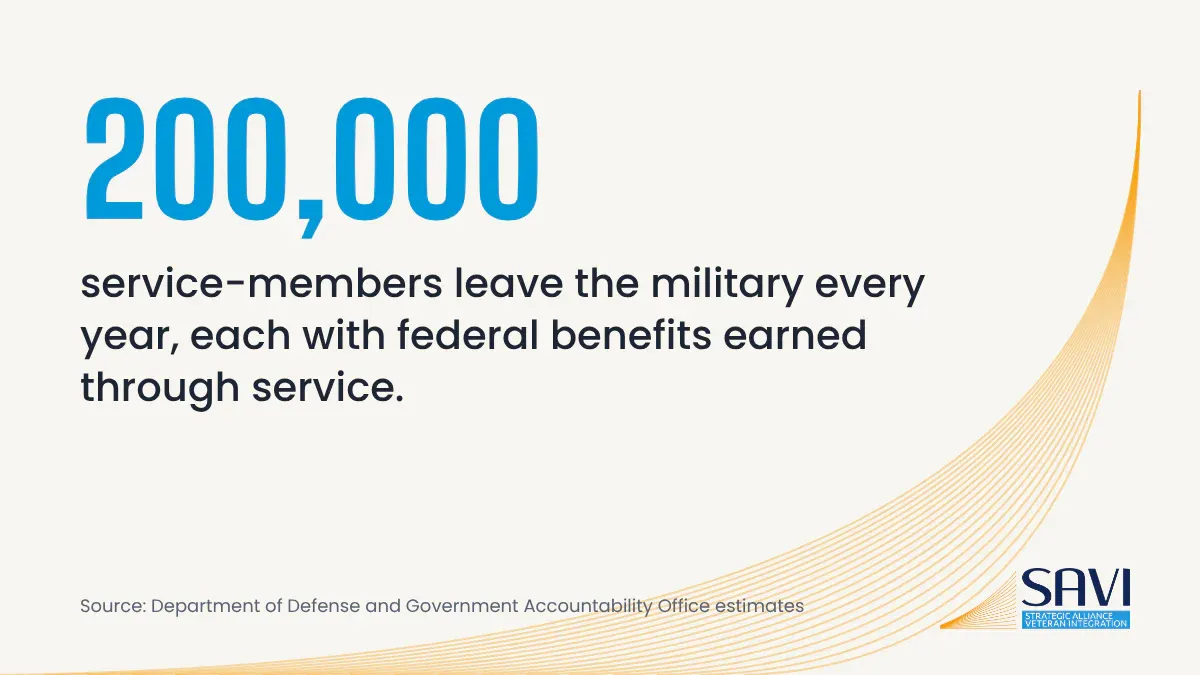
About 200,000 service-members leave the military every year. Each one has earned federal benefits through their service: healthcare, education, home loans, career support, and, for many, disability compensation for conditions that service caused or made worse.
Earned is the important word. These benefits are not gifts, and they are not charity. They are part of the agreement every service-member made with the nation.
Yet federal data cited by Performance.gov shows that around half of recently separated Veterans do not connect with the benefits available to them for several years, and some only in a crisis. Not because they don’t qualify. Because the system is easy to miss when you are starting a new job, moving a family, and learning a civilian life all at once.
A thank you does not close that gap. Knowledge does.
What completes the sentence
When SAVI talks with supporters, we hear the same wish: I want my thanks to mean something. Here is what that looks like in practice.
Thank you for your service, and here is what you’ve earned. Many of the most valuable benefits come with windows tied to a Veteran’s separation date. Some close quietly in the first year. Our free guides lay out the timeline in plain language, and you can share them with any Veteran in your life.
Thank you for your service, and here is someone who can walk it with you. SAVI’s one-on-one coaching is built to meet service-members before they separate and stay with them for 12 to 15 months. Since 2017, SAVI has coached more than 1,570 Veterans one-on-one, and 100 percent of graduates have been awarded a primary federal benefit (SAVI-reported).
Thank you for your service, and we will keep showing up. Gratitude that lasts past November looks like a monthly gift, a volunteer hour, or an introduction to an employer who wants to hire Veterans well.
This Veterans Day
Say the five words. Mean them. Then finish the sentence.
Support a Veteran’s transition
Sources: Performance.gov, “Navigating Transition to Civilian Life,” citing Substance Abuse and Mental Health Services Administration data; Department of Defense and Government Accountability Office estimates of annual separations. SAVI program figures are SAVI-reported.