

There is a date on your discharge paperwork that starts a clock most Veterans never hear ticking. It is not printed anywhere with a warning. No one calls to remind you. And when it runs out, it takes real money with it, money you already earned.
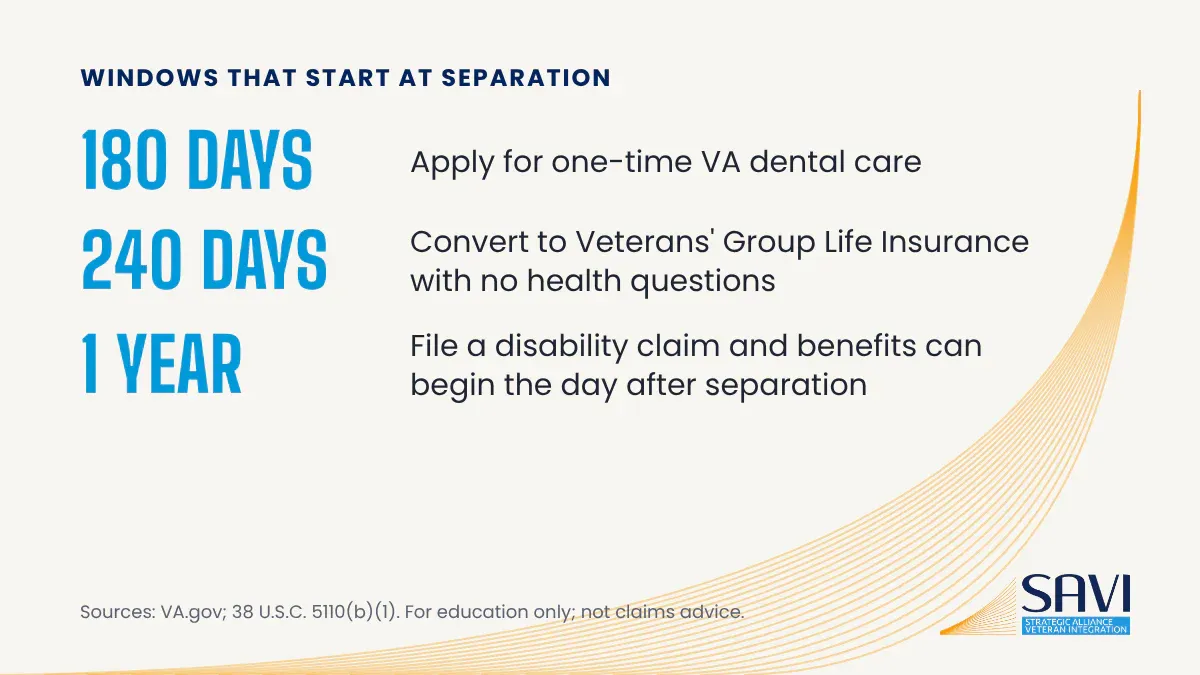
If you leave active service and file your VA disability compensation claim within one year of your separation date, and the claim is later granted, your effective date can reach all the way back to the day after you separated. That is the date your benefits are calculated from, and it is the date your back pay is measured from. File inside that first year, and the months you spent waiting still count. File even one day past it, and the effective date generally resets to the day the VA received your claim. The time in between simply disappears.
That is not a SAVI opinion. It is set in law, at 38 U.S.C. 5110(b)(1), and the VA states it plainly on its own effective-date page: if it receives your claim within one year of the day you left active service, the effective date can be as early as the day following separation. After that year, the most favorable rule in the entire system is off the table, and there is no ordinary way to get it back.
Why this one deadline matters more than the others
Think about what a year of back pay is actually worth. A Veteran rated at 70 percent, filing alone with no dependents, receives more than $1,800 a month in 2026. A year of that is over $21,000. A Veteran rated at 100 percent receives more than $3,900 a month, so a year is over $47,000. That is money the VA will pay if the claim is filed inside the window, and money it will not pay if the claim arrives late. Same disability, same evidence, same Veteran. The only variable is the date.
We say this not to alarm you, but because the fix is entirely within your control, and it is simple.
What to do, in order
File before you separate if you can. The VA’s Benefits Delivery at Discharge program lets you submit a disability compensation claim between 180 and 90 days before your separation date. Filing early through this program does not move your effective date earlier, because benefits cannot begin while you are still on active service, and the effective date for a pre-separation claim cannot be earlier than the day after you separate. What it does buy you is speed. The VA can review your service treatment records, schedule your exams, and evaluate the claim before you take off the uniform, with a goal of delivering a decision within 30 days of separation. That means your first payment can arrive soon after you leave, instead of months later.
If you have already separated, file inside the first year, no matter what. This is the part that saves the money. Even if your evidence is not fully assembled, even if you are still tracking down records, get your claim or your intent to file on record before the one-year mark. An intent to file, submitted under 38 CFR 3.155, holds your effective date in place and gives you a full year to complete the claim. If you finish inside that year, your effective date relates back to the date of the intent to file. If you let it lapse, it protects nothing.
Do not wait for perfect. The most common and most expensive mistake is holding a claim back until it feels complete. A claim on file with gaps is worth far more than a flawless claim filed 15 months out. You can add evidence. You cannot add back time you have already lost.
The other clocks running at the same time
The filing window is the one with the biggest dollar figure attached, but it is not alone. Several other benefits you earned run on their own separation-based deadlines, and they close quietly too.
You have 180 days after discharge to apply for a one-time course of VA dental care if you served the qualifying period and did not receive a full dental exam before you left. The VA’s own guidance calls this window strict, and once it passes, that particular benefit is gone.
You have 240 days after separation to convert your Servicemembers’ Group Life Insurance to Veterans’ Group Life Insurance without answering a single health question. You have a total of one year and 120 days to convert at all. Convert inside the 240-day window and your health, or any condition that developed in service, is simply not part of the conversation.
And if a chronic condition appears within one year of your discharge, it may be eligible for compensation even though it was not rated at separation, which is one more reason the one-year mark matters.
Where SAVI fits
At SAVI, we have spent nearly a decade watching capable, squared-away Veterans lose thousands of dollars to a deadline no one flagged for them. Not because they did anything wrong, but because the system hands you a binder at transition and expects you to find the deadlines inside it on your own, while you are also finding a home, a job, and your footing.
You should not have to. The benefits are yours. You earned them. The only thing standing between you and the full value of them is knowing which coordinate on the calendar to hit, and when.
If you are inside any of these windows right now, the most important thing you can do today is act on the one closest to closing. You do not need the whole map. You just need your next waypoint.
This article is for education only. It is not claims advice. Only a VA-accredited representative may prepare, present, or prosecute a VA claim. To find one, or to learn more about the benefits you earned, visit VA.gov.
Sources: 38 U.S.C. 5110(b)(1); VA.gov, “Disability compensation effective dates”; VA.gov, “Pre-discharge claim (Benefits Delivery at Discharge)”; VA.gov, “Service members separating or retiring from service.” 2026 compensation figures from the VA disability compensation rate tables effective December 1, 2025.